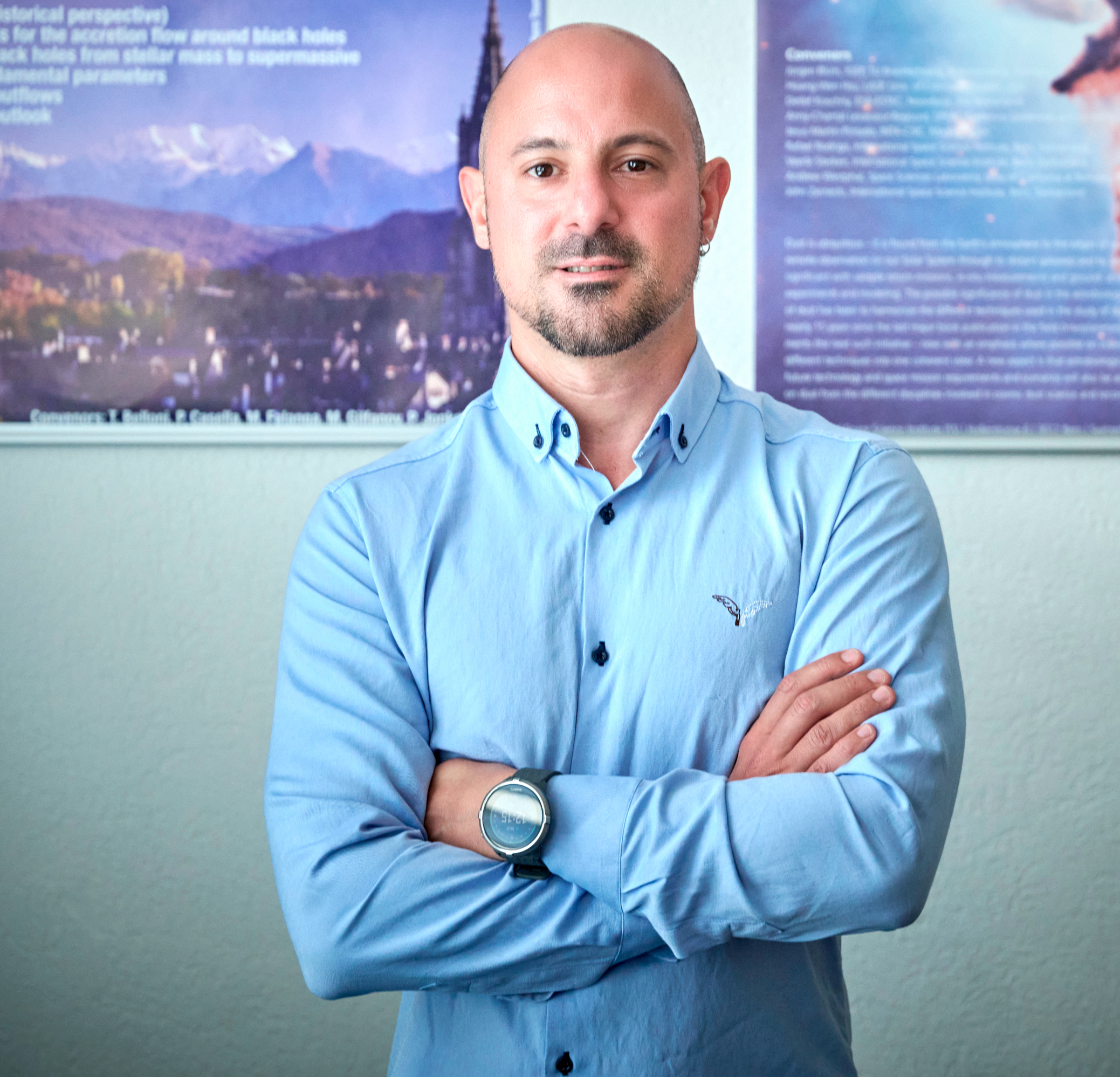
Christian Malacaria, Italian, graduated in Rome with a Bachelor in Physics & Astrophysics, and a Master in Astronomy & Astrophysics. His main research focus is the High Energy Astrophysics. His Master’s Thesis work helped constraining synthesis models of Cosmic X-ray Background from high-redshift Active Galactic Nuclei. He pursued his Ph.D. at the Institute for Astronomy and Astrophysics of Tübingen (IAAT, Germany) in collaboration with the MAXI team at RIKEN (Japan).
Since the Ph.D., his works mainly explore the spectral and timing behavior of accreting X-ray pulsars, magnetized neutron stars in binary systems that represent excellent laboratories of matter under extreme conditions, unattainable on Earth. After the Ph.D. he moved first to USA for a NASA postdoctoral fellowship (Marshall Space Flight Center), then at ISSI (Bern, Switzerland) as postdoctoral fellow. He has expertise in data analysis of X-ray telescopes such as Chandra, XMM-Newton, INTEGRAL, MAXI, Swift, NuSTAR, Fermi-GBM, NICER, and IXPE. His research also includes projects studying the optical emission from the donor companion in X-ray binaries, to link the stellar wind activity with the X-ray emission from the compact object, thanks to observational campaigns with AAT, ESO and SALT on-ground telescopes.
He is also a member of the Neutron star Interior Composition ExploreR (NICER) team, and the Fermi-GBM team working on the detections of Gamma-ray Bursts and electromagnetic counterparts of Gravitational Waves. He started working at INAF-OAR since June 2024 where he began investigating millisecond pulsars observed with X-ray, radio and optical (SiFAP2) facilities. Recently, he was awarded funding as Principal Investigator for the INAF GO program “Observing accreting millisecond pulsars in outbursts: a pathway to the neutron stars’ equation of state”, leading an expert team in a multi-diagnostic observational campaign on high-priority targets.
You can write to him at christian.malacaria@inaf.it